Why Science and Religion Are Separate Domains
- matthewpickering32
- Apr 25
- 2 min read

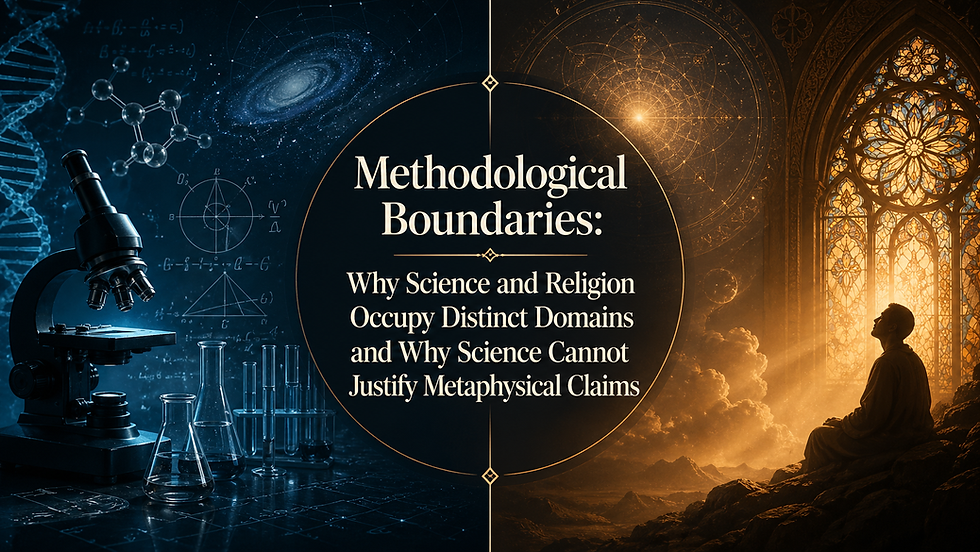
Science and religion deal with different kinds of questions.
Science studies the natural world. It uses observation, experiments, evidence, and testing to explain how things work. For example, science can explain how the universe developed, how disease spreads, how the brain functions, or how evolution happens.
Religion and metaphysics usually deal with deeper questions about meaning, purpose, morality, God, ultimate reality, and why anything exists at all. These questions are often not directly testable in a laboratory.
The main argument is that science is excellent at explaining natural processes, but it should not be used to prove or disprove metaphysical claims. For example, science cannot fully prove that God exists, but it also cannot fully prove that God does not exist. Those are philosophical or theological questions, not purely scientific ones.
A key distinction is between methodological naturalism and metaphysical naturalism. Methodological naturalism means that science looks for natural explanations because that is how science works. It does not automatically mean that only nature exists. Metaphysical naturalism, however, is the belief that only the natural world exists. That is a philosophical position, not something science itself can prove.
Science and religion can overlap when religion makes claims about the physical world. For example, if a religious claim says the Earth is only a few thousand years old, science can evaluate that because it is an empirical claim. But if religion asks about the meaning of life, moral purpose, or ultimate reality, science may not be able to answer those questions completely.
The mistake happens when people use science outside its proper limits. Religious people may wrongly say, “Science proves God.” On the other side, some people may wrongly say, “Science proves there is no God.” Both claims go beyond what science can actually establish.
Science can inform our thinking about religion, morality, and meaning, but it cannot replace philosophy, theology, or metaphysics. Likewise, religion should not override scientific evidence when discussing the natural world.
In conclusion, science and religion are separate but not necessarily enemies. Science answers questions about how the natural world works. Religion and metaphysics ask questions about meaning, purpose, value, and ultimate reality. Keeping these domains separate helps protect both science and religion from being misused.


Comments